
A utility survey is one of the least expensive items on a construction budget, yet skipping it remains one of the most expensive decisions a project team can make. Every year, UK contractors strike tens of thousands of buried cables, gas mains, water pipes and fibre optic networks, and in almost every case the incident traces back to the same root cause: nobody knew, with confidence, what was actually in the ground.
The repair bill is the part everyone sees. It is also the smallest part. Research from the University of Birmingham found that the true cost of a utility strike is many times the direct repair cost once delays, redesign, investigation and disruption are accounted for. This article breaks down where those hidden costs sit, why statutory records alone will not protect you, and how a professional underground utility survey changes the risk profile of a project before a single excavator arrives on site.
The Industry Reality: Why Utility Strikes Keep Happening
The UK has one of the most congested subsurfaces in the world. Beneath a typical urban street you may find Victorian-era water mains, decommissioned gas pipes, modern HDPE ducts, low and high voltage electricity cables, telecoms fibre, drainage runs and private supplies that were never recorded anywhere.
LSBUD, the UK’s shared asset search service, consistently reports tens of thousands of utility strikes across the country every year, and industry bodies widely accept that the real figure is higher because many incidents go unreported. Three patterns show up repeatedly in strike investigations:
- Records were trusted as gospel. Statutory undertakers’ plans are indicative, not verified. Assets are frequently metres from their plotted position, at unexpected depths, or missing from the records entirely.
- Detection stopped at a CAT and Genny sweep. A cable avoidance tool in untrained hands, used without a signal generator or without understanding its limitations, gives a false sense of security. CAT tools struggle with plastic pipes, fibre optics and unenergised cables.
- The survey was value-engineered out. On paper, removing a few thousand pounds from the pre-construction budget looks like a saving. In practice, it transfers an unquantified risk directly onto the groundworks programme.
None of these failures is exotic. They are ordinary commercial decisions made under time pressure, which is precisely why they keep repeating.
What a Utility Survey Actually Involves
A professional underground utility survey is a structured detection and mapping exercise, not a quick scan. In the UK, the benchmark is PAS 128:2022, the specification for underground utility detection, verification and location published by the BSI. A PAS 128 survey classifies information by quality level, so everyone on the project understands exactly how reliable each piece of data is:
- QL-D: Desktop utility records search. Useful context, lowest confidence.
- QL-C: Records reconciled with visible site evidence such as manhole covers, valves and cabinets.
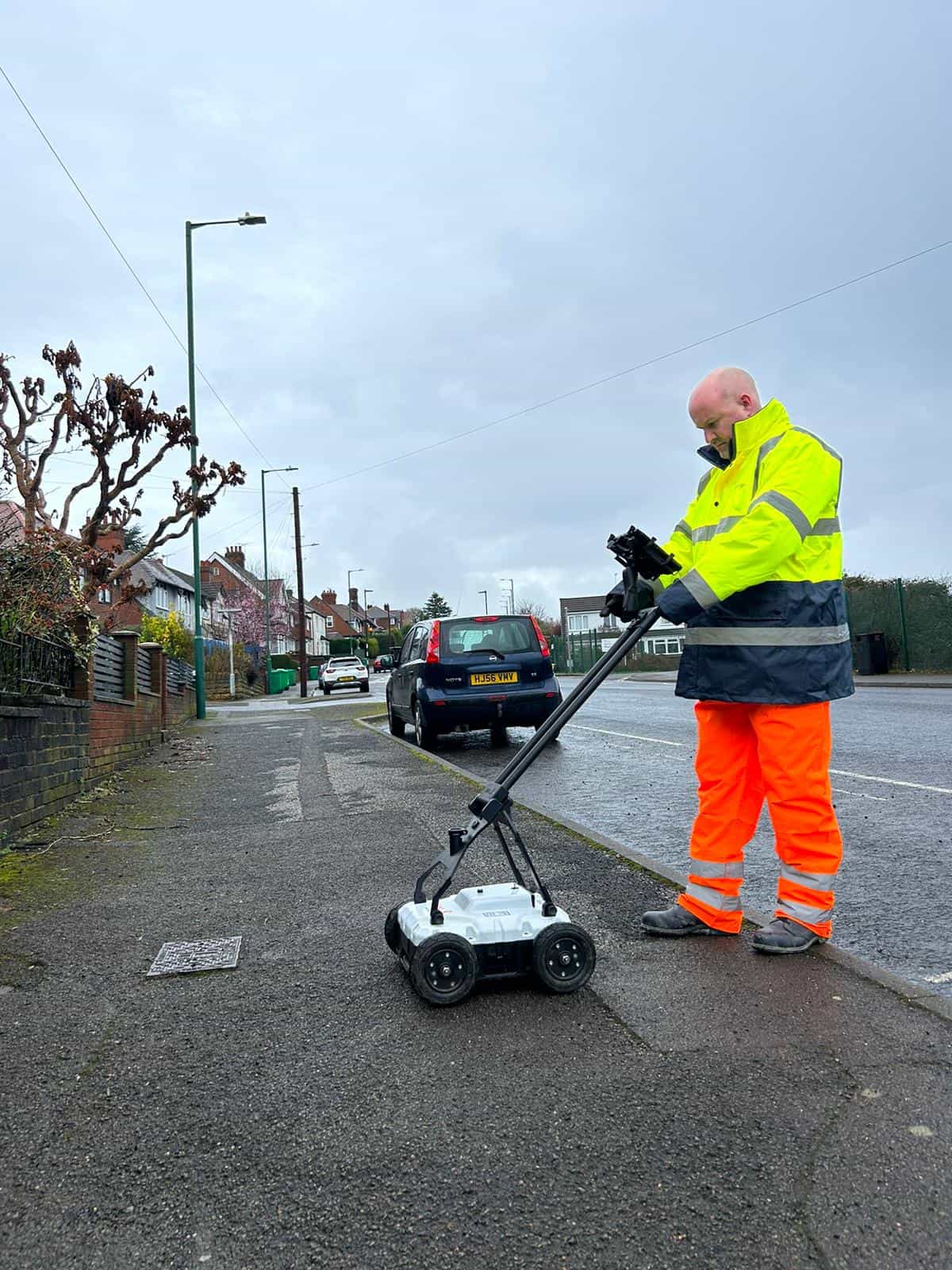
- QL-B: Geophysical detection on site using electromagnetic location (EML) and ground penetrating radar (GPR), with positions and depths recorded to defined accuracy bands.
- QL-A: Physical verification, typically by trial holes or vacuum excavation, giving the highest confidence in position and depth.
The combination of EML and GPR matters. EML excels at tracing conductive, energised services such as electricity cables and metallic pipes. GPR detects non-conductive assets, including plastic water pipes, clay drainage and fibre ducts, that EML cannot see. A survey relying on one technique alone leaves systematic blind spots.
The deliverable is not just a drawing. A good utility mapping report gives designers and site teams a georeferenced CAD or GIS dataset showing detected services, quality levels, depths and, critically, the areas where detection was inconclusive. Knowing where uncertainty remains is as valuable as knowing where the cables are.
The Direct Costs of a Strike: The Bill Everyone Expects
When an excavator bucket goes through a service, the immediate costs are relatively predictable:
- Emergency repair charges from the asset owner, which for a high voltage cable or gas main can run into tens of thousands of pounds
- Plant standing idle while the utility company makes the area safe
- Damaged equipment, from bucket teeth to entire machines in the case of gas ignition or electrical arcing
These figures sting, but experienced contractors can absorb them. It is the second layer of cost that damages businesses.
The Hidden Costs Nobody Budgets For
The University of Birmingham research into utility strike economics concluded that indirect and social costs dwarf the direct repair figure. Here is where that money actually goes.
Programme delay and prolongation
A struck gas main can close a site for days while the network operator investigates, purges and repairs. On a project running liquidated damages of thousands of pounds per day, a single strike can wipe out the margin on an entire package. Follow-on trades stack up, scaffold and welfare hire continues to accrue, and the critical path shifts in ways that ripple through the whole programme.
HSE investigation and legal exposure
Striking a live electricity cable or gas main is a reportable incident under RIDDOR where injury or dangerous occurrence criteria are met. HSE guidance document HSG47, Avoiding Danger from Underground Services, sets the expected standard of care: obtain plans, use locating devices, dig trial holes and adopt safe digging practices. A contractor who cannot demonstrate a competent detection process has very little defence. Prosecutions following cable and gas strikes regularly result in six-figure fines, and sentencing guidelines link penalties to turnover, so larger contractors face proportionally larger exposure.
Injury and human cost
Cable strikes cause serious burns and fatalities in the UK construction industry. Beyond the immeasurable human impact, a serious injury triggers investigation, potential prohibition notices, civil claims and long-term reputational harm. No commercial saving on a survey survives comparison with this outcome.
Redesign and abortive work
Discovering an unrecorded trunk main after foundations are designed forces redesign, resubmission and sometimes renegotiation of the build sequence. Piling layouts, drainage falls and service connections may all need rework. This is where utility mapping earns its keep at the design stage rather than the construction stage: moving a foundation on a drawing costs almost nothing, while moving it on site costs a fortune.
Third-party and community disruption
Severing a fibre trunk can take businesses, hospitals or emergency services offline. Asset owners increasingly pursue consequential loss claims, and local authorities remember contractors who shut their high street for a week. On framework agreements, a poor strike record can quietly influence future tender scoring.
Why Statutory Records Are Not Enough
Requesting utility plans is a necessary first step, and services such as LSBUD make the process faster than it has ever been. But records searches have structural limitations that no amount of diligence can overcome:
- Plans show approximate alignments, often without reliable depth information
- Older assets may be plotted from pre-digital records with significant positional error
- Abandoned services are frequently left in the ground and out of the records
- Private services, from estate lighting to farm water supplies, rarely appear on any statutory plan
- Recent works, diversions and repairs can lag the records by months
A records search corresponds to PAS 128 quality level D. Treating QL-D information as if it were verified survey data is the single most common thread in strike investigations. An underground services detection survey exists precisely to close the gap between what the paperwork says and what the ground contains.
Real-World Scenarios Where a Utility Survey Pays for Itself
Consider three situations that surveyors across the UK encounter constantly.
The brownfield redevelopment. A developer acquires a former industrial site in the Midlands. Statutory records show two services crossing the boundary. A QL-B GPR survey identifies eleven distinct linear anomalies, including a live private electricity supply feeding a neighbouring unit and a redundant fuel line. The piling layout is adjusted at design stage. Cost of the survey: a few thousand pounds. Cost of striking the private supply mid-pile: an insurance claim, a neighbour dispute and a stopped rig.
The highways improvement scheme. A contractor plans night-time works on a junction. Records show telecoms on one side of the carriageway. EML tracing reveals the fibre duct actually crosses diagonally beneath the proposed drainage run. The trench alignment shifts by two metres before mobilisation. Nobody outside the project team ever hears about it, which is exactly the point. The most successful utility surveys are the ones that make problems disappear before they exist.
The school extension. A measured building survey and topographical survey are commissioned for an extension. Adding a utility survey to the same mobilisation reveals that the assumed drainage connection point is a decommissioned run, and the live foul sewer sits under the proposed foundation line. The architect amends the layout during RIBA Stage 3 rather than during groundworks in term time.
In each case, the survey did not merely find pipes and cables. It changed decisions while those decisions were still cheap to change.
Timing Matters: When to Commission an Underground Utility Survey
The value of utility detection collapses the later it arrives. As a working rule:
- Feasibility and land acquisition: A desktop search and QL-C reconciliation flags major constraints that affect viability and value.
- Design development: A QL-B EML and GPR survey feeds accurate utility mapping into the design model, allowing foundations, drainage and service routes to be coordinated around reality rather than assumption.
- Pre-construction: Targeted QL-A verification by trial holes or vacuum excavation confirms critical crossings and clearances before excavation begins.
- During works: Additional tracing supports safe digging practice where the ground tells a different story from the drawings.
Combining a utility survey with a topographical survey or 3D laser scanning during the same site visit is often the most efficient route, since one mobilisation produces a complete above-ground and below-ground picture of the site.
How Premier Surveys Approaches Utility Detection
Premier Surveys has been delivering surveying and geospatial services across the UK since 1989, working from offices in Nottingham and London on projects spanning construction, infrastructure, utilities and property development. Our utility surveys are carried out in line with PAS 128 using both EML and GPR detection, delivered by experienced surveyors and backed by an ISO 9001:2015 certified quality management system and RICS regulation.
Because we also provide topographical surveys, measured building surveys, CCTV drainage surveys, 3D laser scanning and GIS data capture, clients can commission a coordinated dataset in which underground services, surface features and drainage condition all align in a single georeferenced model. That integration removes the coordination errors that occur when separate suppliers deliver separate fragments of site information.
The Real Question Is Not Whether You Can Afford a Survey
The economics of utility strikes are asymmetric. A utility survey in the UK typically costs a small, fixed, known sum. A strike costs an unknown, potentially unbounded sum that can include programme collapse, prosecution and serious injury. Framed that way, the survey is not a cost at all. It is the cheapest insurance a groundworks package will ever buy, with the added benefit that it improves the design rather than merely protecting it.
If your project involves excavation, piling, drainage or any intrusive groundworks, commission underground utility detection before the design is frozen, not after the first bucket goes in. To discuss a PAS 128 utility survey for your site anywhere in the UK, contact Premier Surveys through premiersurveys.co.uk and speak to a surveyor about the right quality level for your project.
FAQ Suggestions (Optional Schema Opportunities)
How much does a utility survey cost in the UK? Costs depend on site size, access and the PAS 128 quality level required, but a typical survey represents a small fraction of the cost of a single utility strike.
What is the difference between GPR and EML? EML traces conductive services by detecting electromagnetic signals, while GPR uses radar pulses to detect both conductive and non-conductive assets such as plastic pipes and fibre ducts. Professional surveys use both.
Is a PAS 128 survey a legal requirement? PAS 128 is a specification rather than legislation, but HSE guidance HSG47 expects contractors to locate services before digging, and a PAS 128 survey is the recognised way to demonstrate that standard of care.